On Unresolved problems of Part Whole Hierarchies
P.S. This is a speculative, scientifically inaccurate post, which does not surpass any state of the art . The problem between science and philosophy is that experiments can show extremely implausible ideas like gradient descent are just right, and intuitive ideas like part-wholes are incorrect.
Indeed, we must learn from sutton’s bitter lesson: given enough data, a brute-force algorithm like transformer, can surpass anything we care to invent. There is no way to deny that scaling leads to increased performance. And indeed, people have moved onto better things, for eg, diffusion, gflownets, and recurrent models of thinking.
At this juncture, all we can do is wonder. Were we wrong all along? And indeed, we have nothing respectable to show for it, even after half a decade (except APM by your truly 😬).
A risky bet indeed.
One of the big mysteries is if one should bet on encoding part whole hierarchies in neural nets. Indeed, there are high chances it is a WRONG bet.
One reason to still stick to it is that geoff hinton wrote about it 4 decades ago, and even 5 years ago. And perhaps he deserves to be listened to, given the amount of successful bets he made, although some took decades to pan out. But, by all means, he is a winner.
There are only two other people who took this issue seriously. By serious, we don’t mean that someone spends two months on it, forks a github library, finds it does not beat a benchmark and then gives up.
The seriousness we are concerned here with borders on borderline obsession, a constant aching itch in the head that something about AI is wrong. One problem with obsession is that it leads to arrogance: you start thinking what you say is the only way, and there are no alternate paths. So, one needs to be careful as to not make such blunders.
Who were those two people?
First, Jeff Hawkins in his book Thousand Brains. He eventually founded Numenta, and Celeste/Vivian/Sabutai (and team) there are doing some pretty cool work on theories of neo-cortex/ sparse-distributed memories. Some curious comments on Numenta’s work can be found here
Similarly, David Marr in his Vision book, investigated the nature of coordinate frames, and higher order shape representations in the brain.
Finally, Hinton spent a couple of decades arguing for shape invariance/equivariance of rigid bodies, thereby closing this love triangle. Please note Hinton never talked about dynamics of moving bodies, since that gets messy really fast. Proponents who claim to work on video, often add time as an additional dimension, and just create 3D versions of image models.
So, we will stick to the same assumptions of rigid bodies for now, in spirit of original capsule paper (and Ramon Y Cajal :-)). For now, indeed, it appears we are alone on this problem, but we will gladly but our eggs in this basket, for we have not yet found a better one. And trust me, we have looked. You can check it here.
We shall now merely attempt to formally lay down those problems (for anyone who may be interested). Some of these, are articulated in-verbatim from other papers and some are the ones derived of our own musings, or discussions among the secret members of the knights templar.
Whatever progress will be made, might have to rest on the shoulders of geometric deep learning, and graphical models for structured learning.
The Lost Problem of Knights Templar
The problem we are interesting in solving can be explained with the help of a face. Please gaze at the face presented below.
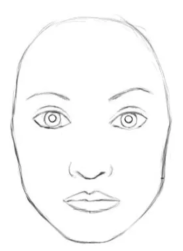

(a) For all sense and purposes, you will consider this face to be upright, at an angle of 90 degrees with regards to x axis.
(b) We are interested in breaking this face into a part-whole parse tree. Basically, it is a data structure in which a lower level 1 represents the parts, and a higher level 2 represents the entire face (whole). Each node in this tree consists of an arrow. For eg, here nose’s arrow is also at 90 degrees, whereas arrow through lip is at 0 degrees. Thus, nose and lip are both perpendicular to each other. Similarly, nose is at the same angle as that of the face.
This is an interpretation which we grow up to take for guaranteed.
However, an alternate case is possible.

It is possible to structure a tree in which the arrow through the face makes 135 degrees, nose 45 degree, and lip 135 degree. In such a situation, nose is at 90 degree angle to face, whereas lip/face are parallel to each other.

Thus, from a face’s perspective there are infinite lines which could pass through it’s center. Similarly, infinite lines can pass through lip.
Of those infinite lines, there is only one 1 red line which humans seem to prefer for the face as the choice of coordinate axis, and similarly for lip.
However, in the image pixel space, there is no constraint governing “which” of the lines should be explicitly preferred by a neural network (since a face is an oval/circle for fat guys like me, and any line passing through the face divides it into two identical semicircles, which means it has infinite symmetry).
The canonical lock
An alternate name is the problem of rotating potatoes, first posed in GLOM. Funnily, this is also the core reason that capsules didn't work. (Please dont tell me they ever did, i will just roll my eyes. Merely stacking capsules, and training them to get sota results doesnt mean that they really work).
Now, we will try to define this problem.
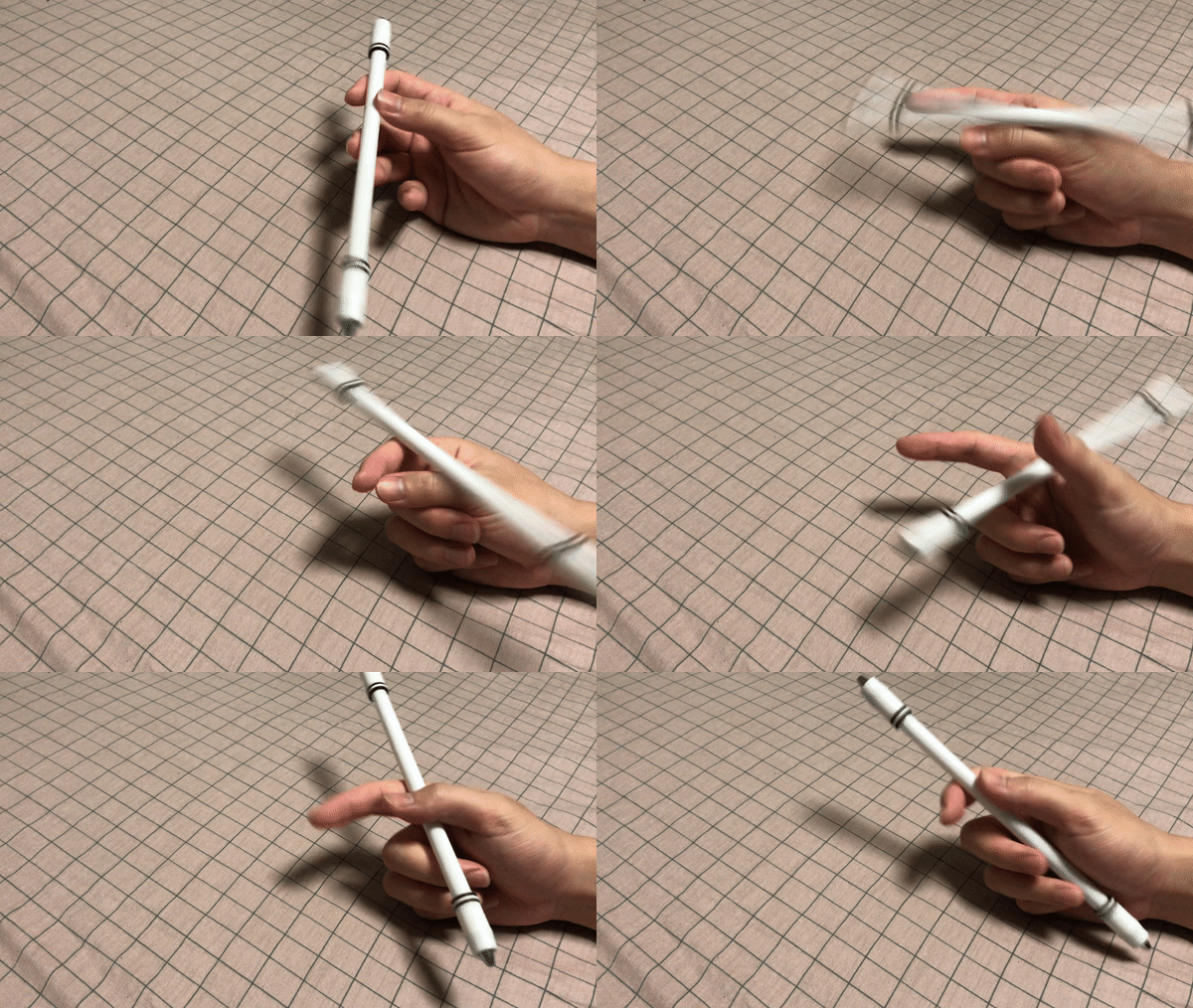
face
lip
Consider the pen given above. There are two copies of the same pen. One pen represents the face. Another pen represents the lip. Both the pens are having a phase difference in their motion. However, their trajectory is identical.
Computationally, you can think of these two pens as two vectors rotating in a higher dimensional space. For clarity, here we can assume those two vectors in the 2d space.
At any moment, the rotations of these two vectors is independent of one another. Now let us further imagine, again a face consisting of nose and lip.

The picture (left) above assumes that the lip is horizontal, nose is vertical, mutual angle is 90 degrees. On the (right), we rotate the image by a little bit. Both the lip, and nose rotate a little bit, but the mutual angle between them remains constant. For the purpose of this post, we shall only focus on 2D images, and their rotations.
We will not focus on a 3D scene with two images belonging to same scene , but with differing viewpoints.
Similarly, now consider the image below:

Here we choose two different vectors which may pass through nose/ lip. (left) vector through nose is horizontal, and through lip is downwards. (right) even thought the face rotates, the mutual angle is ninety degrees.
On surface, we may ask: hey dude, why look at a face, why not real world image?. The reason is that such a thought experiments helps abstract away a few principles:
[1] Internally, a computational model of brain would rely on vectors, which can exchange information with each other. The way these vectors interact, leads to the internal structure.
[2] If the vectors of face, and lip rotate independently, and are given the freedom to choose whatever they want, there is no meaningful structure we may learn.
[3] If the vectors of face, and lip rotate together in a space such that the relative orientation between them remains constant, then we may learn something meaningful.
[4] The relative magnitude of orientation between these vectors matters. In other words, we need to be able to understand whether one is lagging behind or moves forward with respect to another.
This becomes evident in picture (i) where if we assume the basis vector to be the line passing through the lip, the nose makes +90 degree. Whereas in picture (ii), the same constraint of + sign holds.
The machine must choose among one of the many plausible relative angles (hypothesis) between parts and wholes
If the vector of the whole (face) and the part (lip) can rotate independently, the machine must decide over multiple iterations, what is the relative angle between them.
To investigate this, we need to conduct some thought experiments. For fun, we will treat this experiment as a parody of sorts between a part and whole.
A single part and a single whole, in a mutual relationship together
Let us imagine the most simple case, when there is only one whole and one part. Let’s imagine data generating process $f$ produced two vectors $v_{whole}$ and $v_{part}$. These vectors are now going to undergo an agreement protocol, to decide what will be their relative orientations. Eventually, they will form little islands of agreement.
We are considering a timestep $t$ in GLOM. The part advertises a vector to the whole. Let’s get into the parody.

Part: Dear nose, my vector is $v_{part}$ . I think you are my real daddy (whole)
Whole: Really dude, then you should look like me. Let me see how similar are you to me
Whole takes $v_{part}$ and projects it onto itself. Lets call it $Proj<v_{part}, v_{whole}>$.
Then whole substracts this proj from $v_part$ to get the component in the perpendicular direction. If that component is small, then it means $v_{part}$ is similar to whole.
Whole: Hey man, i just finished checking, you are still a lot different than me, so i don't think you are my son. You better go find other dad
Part went really sad. He really wanted to be whole’s son. Rrecall that this was single part-whole case. If whole didnt accept him, he would be orphaned. And world does not look kindly to orphans.
Part: You are the only whole left in my world . I really want to be your son
Whole: Geez. Then you gotta look like me
Part: Sure, what to do?
Whole: Ok, here is a value: $Proj<v_{part}, v_{whole}>$, subtract it from yourself, and you will become same as me
Part: Sure
Part then does $v_{part} = v_{part} - Proj<v_{part}, v_{whole}>$. Next time it shares the vector $v_{part}$ with whole, he accepts him as his kid.
However, it creates a problem: something we call collapse in this messy business. Part and whole are identical vectors. A similar case happens when part in turn act as a parent to a sub-part at a lower level. Basically, you can imagine every vector in the network starts looking similar to one other, and we have a big mass of homogenous population. And where is the fun in life, if there is no variety?
One other problem (or as i like to shamelessly call it a desirable property) here is that part was able to rapidly change its vector in a single iteration. It didn’t need many iterations of learning.
Preventing collapse with non-linearity
The problem where $v_{part}$ becomes equal to $v_{whole}$ could be solved by imagining a matrix $w$. Basically, $w$ multiplies this part $v_{part}$ and outputs a new vector $v’$. This v’ should be similar to $v_{whole}$.
If we make a simplistic assumption that $w!=I$, where $I$ is identity matrix, then we can prevent such a collapse. And indeed, if $W$ is a neural network with non-linearities in between, it is very hard for collapse to occur.
So, the figure above now starts looking a bit like:

Let us call the $W$ matrix a bottom-up network, since it takes a vector from part, and transforms it into a vector $v’$ through which the whole can measure the agreement. Please note that the figure above refers to lip as part, nose as whole. Therefore, i shall internchangebly use $v_{part}= v_{lip}$ and $v_{whole} = v_{nose}$
It now becomes important to look at the machine from two different perspectives. There are only minor differences technically, but it leads one to interesting interpretation.
Perspective 1: The matrix w is NOT changed during agreement phase

Here, the vector part advertises to whole is $v’ = W v_{part}$. From whole’s perspective, it does not have access to $W$. Then, the whole measures projection error $e = Proj<v’,v_{whole}>$. Next, the whole needs to pass some information to the part so that it can make a correction. But, it cannot merely pass error $e$, since $v’$ was computed when it got transformed via weight matrix $W$.
So, the correct information the whole needs to send the part is $W^{-1}e$. Let us now make the assumption, which is intrinsically wrong, but convenient:
There exists an easy way to compute $W^{-1}$
Once the part receives this information, it can make an update $v_{part}- e$. And voila, we have achieved locking!! What do we mean by locking?
The condition for interdimensional lock.
If the machine manages to achieve a perfect lock, the following constraint will hold. $W v_{part}$ will give $v_{whole}$. Similarly, $W^{-1}v_{whole}$ will give back $v_{part}$. We can check this by putting $W v_{part}$ in place of $v_{whole}$, which gives , $WW^{-1}v_{part}$, and indeed, the two W’s cancel out, and we get back $v_{part}$.
Next, let us tackle our earlier assumption. Is it possible to compute $W^{-1}$. Well, if bottom-up network is a neural net with many layers, each layer matrix $W$ can (in theory) be inverted. However, there are indeed cases, when no matrix exists. This means that the problem can be solved in two ways (i) either force bottom up net to have weights whose inverses are possible. (ii) accept that this is a issue, and find a way to bypass that.
Perspective 2: Finding the alternate to computing $W^{-1}$

We can imagine that instead of computing $W^{-1}$, we have a top-down neural net with weights $W’$. Now, we can make two design choices:
[1] W is kept fixed. No learning.
[2] $v_{whole}$ is kept fixed.
[3] Only $v_{part}$, and $W’$ can be changed.
[4] Architecture of W’ is mirror symmetry of W.
A learning algorithm then modulates the weights of top-down network W’ as follows:
[1] First, $v_{part}$ is multiplied by $W_{bottom-up}$ to yield $v’$.
[2] Next, the whole computes e = $proj<v’,v_{whole}>$
[3] We feed-forward $e$ through $W_{top-down}$ network to yield output $v_{out}$
[4] $v_{out}$ should be equal to $v_{part}$. If not, backpropagate error, and update top-down network $W’$
Reasons behind mirror symmetry: The top-down neural network $w’$ has to be forced to learn a weight matrix $w^{-1}$. The catch is that we don't want to take the inverse. Each layer of $w’$ is same as $w$. Let us imagine looking at layer l of both.
We can then imagine enforcing $w_{l}w’_{l} = I$. Basically, multiply the matrices of both layers,and they should become the identity matrix. If you multiply this equation by $w^{-1}_l$ on both sides,
you get $w^{-1}_l w_l w’_l = w_l^{-1}$, which simplifies to $ w’_l = w_l^{-1}$.
This means that $w^{l}$ will tend to learn the inverse matrix. The trick here is that we never took inverse, but merely forced the product of matrices to become identity. One can then imagine doing this for every internal layers of $w’$. This is only possible when $w’$ is mirror image of $w$, thereby justifying the design choice of mirror symmetry. Since this involves aligning weight matrices together, we call this procedure deep weight alignment. Indeed, a very similar idea called random feedback alignment was also proposed by Timothy Lillicrap in his Backpropagation and Brain Paper. The mirror symmetry then becomes similar to bifold symmetry in DNA, and isomers/chirality of molecules.
Calibration of $w'$: Once the weights of top-down network have been updated over several gradient descent iterations, it has become calibrated to $W$. At this point the part/ whole have a relative rotation matrix of $W$.
Resisting the temptation to supervise rotation matrix W
Given a part, and a whole, there are infinite rotation matrices $W$ which could be used to transform the part into the whole. Which of those is the correct one? And again, this boils down to a physical symmetry question. One beautiful thing i realized, is that symmetries are all over the place. It is not merely a construct of physics, but a fundamental law of nature. And for curious reason, nature prefers left-handedness more than right.
There are only two plausible answers. Let us now consider both, for that shall reveal the next choice we must make.
Answer 1: There exists a UNIQUE $W$ for every pair <part/whole>
This school of thought believes that given a lip, and a nose, they should definitely lie perpendicular to each other (because psychological evidence points that every human favours this constraint). The matrix $w$ which makes those vectors orthogonal is the only correct answer.
If we accept orthogonality, we can supervise bottom-up neural net to learn $w$ corresponding to that. This means that, we know in advance a precise W for every pair of <part/whole>. And indeed, that is what 3D computer vision guys (and gals) do. And they do it quite well.

Let us deviate from our original discussion. Consider the car shown above. It can be viewed from different viewpoints. The car is a rigid object.
Next, consider any two cameras (let’s call them Cam 1, Cam 2) with rotation matrices $R_1, R_2$. It does not matter which coordinate you choose as the world origin, for the relative rotation between this cameras will not change. More precisely, you can go from Cam 1 $\rightarrow$ Cam 2, by a transition matrix $R_2^{-1}R_{1}$.
Now, let us consider the case that the world origin is shifted by a matrix $M$. Let $R_1$ and $R_2$ be the original orientations.When you apply a global rotation $M$ to your camera system, the individual rotation matrices update to $R_1^{new} = M R_1$ and $R_2^{new} = M R_2$.
To find the new transition matrix, we can calculate $\Delta R^{new} = (R_2^{new})^{-1} R_1^{new}$, which expands to $(M R_2)^{-1} (M R_1)$. Using the algebraic property that the inverse of a product is the product of the inverses in reverse order, this becomes $R_2^{-1} M^{-1} M R_1$. Because $M^{-1} M$ equals the identity matrix $I$, the global shift $M$ cancels out completely, leaving you with $\Delta R^{new} = R_2^{-1} R_1$.
This proves that the relative orientation between the two cameras is a rigid-body invariant; while their individual orientations relative to the world change, their orientation relative to each other remains constant.The dudes in 3D computer vision, were quick to exploit this invariance property. This meant that a simple camera-head on top of a neural network, could learn the relative coordinate transformations.
However, the problem of rotating potatoes remains a problem in 2D images, since the relative transformation between a part-whole keeps changing, which prevents the neural net from converging.
The temptation: It is tempting to define a random transformation matrix between a part and a whole, and then supervise the neural network accordingly. While in principle it could work, it makes no sense: the job of the neural net is to encode structure and not the noise. Unless, there is a precise logic, by which you may choose the 2D objects rotation matrix, it just won't work.
I am tempted to now re-introduce the image from David Marr’s book, albeit with some changes (by yours truly 😬). So here we go:

On leftmost part (i), we show a bucket (or a cylinder), and wonder: what is the best canonical frame which passes through it. An intuitive thought is, let's choose one of the surface normals. Indeed, (ii) shows several surface normals. However, the issue is there are many normals, which one should we choose. A better hypothesis is the central axis (iii): the one passing through the object center. It follows something what i call spherical symmetry.
Even if you rotate the cylinder by a little amount, it remains identical. This seems to suggest that humans choose canonical axis, which have higher degrees of freedom. By degree of freedom, we mean, the shape (aka cylinder) remains identical, even by moving a normal amount $\theta$. Assuming total possible rotation to be $360 degrees$, degree of freedom (d.o.f) = $\frac{360}{\theta}$. The higher this number, the simpler the hypothesis, and more probable it is choose. For the case of bucket, it tends to infinity. The problem then reduces to how does a neural net estimate the degree of freedom of rotating an object from various viewpoints, and choosing onto the correct frame to lock onto.
Marr was indeed a smart dude worthy of immense respect: given the tools of his time, he correctly predicted the nature of higher constructs of mental imagery and shape recognition. The most important chapter of his vision book is the last one: representing shapes for recognition. And indeed, that is the problem hinton chipped away at for over two decades lol. And now, this brings us back to the same problem of part-wholes.


This is a piece of underlined text in my writing.
It advertises three or four possible relative angles that the lip/face could have relative to each other.
Pictorially, this constraint is represented by:
Should parse-tree be linearized?
By synchronization we mean, that the
Imagine the pen to be an arrow which is rotating constantly in a spae.
unstability till infinity
oscillator visualization
does not scale to higher dim
analysis of encoding in phase vs magnitude
- destruction of info as we go deeper.
inversion of part-whole - fergus work - my work - their work - why i was wrong.
phase based multiplexing
thinking that the features form hierarchy
how to evaluate it.
marr’s obsession with coordinate frames, hawkins, eventually hinton
the canonical lock
why it cannot be solved
nlp connection in parse trees.
no way to evaluate it
why i should look at unconstituency parsing..